Donald Trump says US blockade of Iran’s ports will start on Monday
Trump says U.S. naval blockade of Iranian ports to begin Monday.
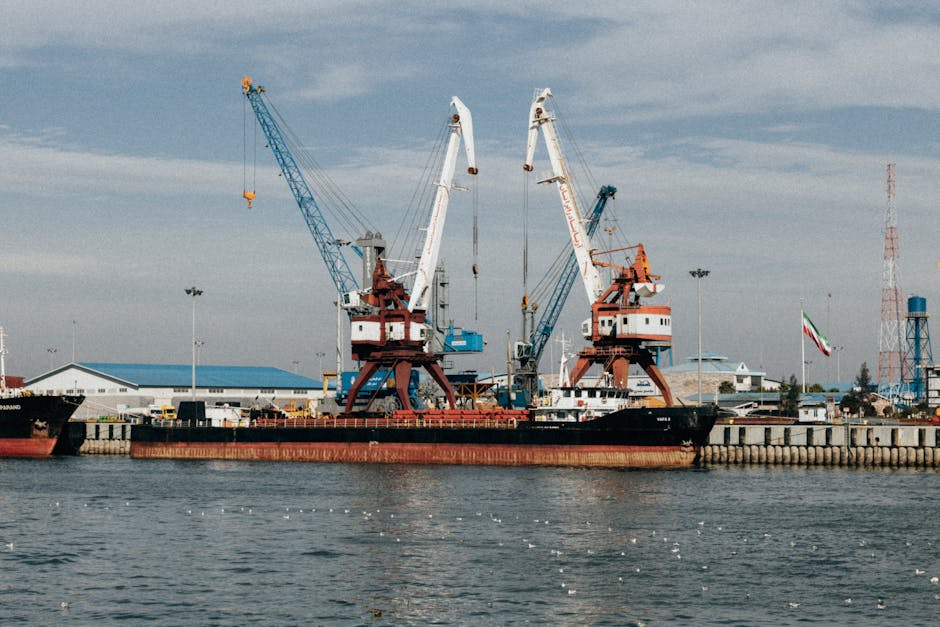
Image: GlobalBeat / 2026
US Iran blockade: Trump orders naval shutdown of Iranian ports starting Monday
Muhammad Asghar | GlobalBeat
President Donald Trump announced the United States will impose a comprehensive naval blockade on Iran beginning Monday, sealing all Iranian ports to commercial and energy shipments.
The blockade marks the first time since the 1988 Tanker War that the US has moved to strangle Iran’s maritime trade entirely, with Trump declaring Tehran “will not sell one barrel of oil” while tensions persist.
The decision lands six days after Iran test-fired a ballistic missile capable of reaching Israel and two weeks after the Islamic Revolutionary Guard Corps seized a Marshall Islands-flagged tanker in the Strait of Hormuz. Oil prices leapt 7 percent on the news, pushing Brent crude past $95 a barrel for the first time since October.
Trump revealed the move during a hastily arranged press pool spray at Mar-a-Lago on Saturday evening, saying the Navy’s Fifth Fleet had received “execute orders” earlier in the day.
“Effective 00:01 Eastern Monday, no vessel will enter or leave Iranian territorial waters without American inspection,” the president told reporters. “Any ship attempting to breach the blockade faces interception, seizure, or disabling fire.”
Defense officials said the operation will involve two carrier strike groups already positioned in the Gulf of Oman, plus a French frigate and British destroyer that joined the American flotilla last week. More than 5,000 Marines embarked on the USS Bataan will board suspect tankers, while destroyers escort compliant ships to designated anchorages for cargo checks, according to a Pentagon briefing slide circulated to Congress.
Iran’s foreign ministry responded within minutes, calling the plan “piracy on an international scale” and warning of “immediate, calibrated retaliation against Western economic arteries.”
Foreign Minister Abbas Araghchi wrote on X that Tehran had summoned the Swiss envoy—who handles US interests in the absence of formal relations—to receive a protest letter threatening “reciprocal strangulation” of shipping through the Strait of Hormuz. Roughly 20 percent of globally traded oil passes through the 34-mile-wide chokepoint.
Regional governments braced for fallout. Kuwait instructed its state oil company to activate emergency export pipelines to Saudi Arabia’s Red Sea coast, while Qatar ordered the liquefied natural gas carrier Al Sadd to anchor inside port rather than risk interception, ship-tracking data showed. The United Arab Emirates, hosting the region’s biggest bunkering hub at Fujairah, closed anchorages to outbound Iranian-linked vessels, port agents said.
Israeli Prime Minister Benjamin Netanyahu endorsed the blockade, saying his cabinet had approved intelligence-sharing and aerial refuelling support for the US-led flotilla. Russia and China both condemned the measure, with Beijing’s UN envoy calling it “a textbook act of gunboat diplomacy that endangers world energy security.”
Energy analysts warned the clampdown could remove up to 1.4 million barrels per day of Iranian crude from an already tight market, raising US gasoline prices by 30-40 cents a gallon before the summer driving season.
“This is not sanctions, this is a maritime siege,” said Richard Bronze, head of Middle East research at Energy Aspects in London. “Even if China keeps buying Iranian oil, the insurance market will collapse overnight because no underwriter will risk a VLCC caught in a cross-fire.”
The Trump administration did not seek advance congressional approval, arguing the president’s authority as commander-in-chief covers “defensive measures against Iranian provocations.” Lawmakers from both parties demanded an immediate classified briefing, with Senate Foreign Relations Chair Senator Chris Murphy warning that “blockades are acts of war under international law” and requesting a closed-door session on Tuesday.
Background
The US last mounted a large-scale naval embargo against Iran during the 1987-88 Tanker War phase of the Iran-Iraq conflict, when American warships escorted Kuwaiti tankers and traded fire with Iranian speedboats. That operation, codenamed Earnest Will, saw the US Navy destroy two Iranian oil platforms and accidentally shoot down an Iranian civilian airliner, killing 290 people.
Washington has relied primarily on economic sanctions since withdrawing from the 2015 nuclear accord in 2018. The Treasury Department claims those measures cut Iran’s oil exports from 2.5 million barrels per day to as low as 200,000, though volumes rebounded to roughly 1.5 million this year as China disregarded restrictions. Iran’s economy has shrunk by 20 percent over six years, inflation topped 50 percent last spring, and the rial hit a record low of 690,000 against the dollar in March.
Iran’s naval doctrine centers on asymmetric tactics, including coastal missile batteries, mini-submarines, and swarms of fast attack craft that train to swarm larger warships. The Revolutionary Guards’ navy staged a major drill in March featuring 50 speedboats, drone-launched missiles, and a simulated drone strike on a model US carrier. Tehran has also planted sea mines in the strait before; a limpet mine damaged the Japanese tanker Kokuka Courageous in 2019.
What’s Next
The Pentagon expects the first interception attempts within hours of the order taking effect Monday, when at least 11 tankers carrying Iranian crude are scheduled to load at Kharg Island. Tehran has signalled it may respond by deploying sea mines, firing anti-ship missiles from mobile launchers along the coast, or ordering allied militias in Iraq to target US bases with drones. European diplomats say they will seek an urgent UN Security Council session on Tuesday, though any resolution would likely face US and potentially British vetoes as London has indicated “conditional” support for the operation, contingent on civilian safeguards.
If Iran successfully retaliates, global insurers could revoke coverage for the 2,000 ships that transit the strait monthly, rerouting Saudi, Iraqi, and Kuwaiti exports around Africa and adding 15 days to delivery times to Europe. The International Energy Agency has begun drafting release terms from strategic petroleum reserves held by the US, Japan, and EU member states, with initial volumes possibly reaching 60 million barrels, according to an official familiar with the discussions.
Senior Correspondent, World & Geopolitics
Muhammad Asghar covers international affairs, conflict zones, and US foreign policy for GlobalBeat. He has reported on events across the Middle East, South Asia, and Eastern Europe, with a focus on the intersection of diplomacy and armed conflict. He has been writing wire-service journalism for over a decade.