Iran War Live Updates: U.S. Blockade Around Strait of Hormuz Will Last ‘as Long as It Takes,’ Hegseth Says
Defense Secretary Hegseth says U.S. naval blockade of Strait of Hormuz will continue indefinitely until Iran abandons nuclear program.
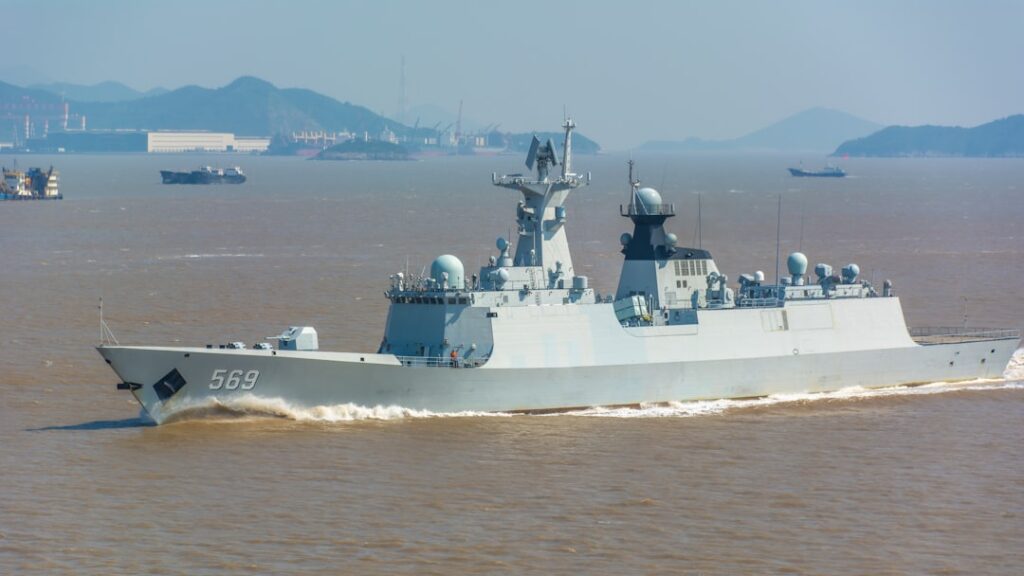
Image: GlobalBeat / 2026
U.S. Military Blockades Iran Strait of Hormuz Indefinitely, Pentagon Chief Warns
Muhammad Asghar | GlobalBeat
The United States has sealed off the Strait of Hormuz with warships and fighter jets and will keep the chokepoint closed “as long as it takes,” Defense Secretary Pete Hegseth announced early Tuesday.
Hegseth, speaking outside the Pentagon at 3 a.m., gave no fixed end date for the operation that began Monday night after Iranian speedboats allegedly fired on two commercial tankers. Shipping insurers immediately voided coverage for any vessel transiting the 21-mile-wide waterway, freezing a route that carries one-fifth of the world’s oil.
The strait is Iran’s economic lifeline. Every day Tehran ships roughly 1.5 million barrels of crude through the channel, generating about $120 million in daily revenue. Closing it squeezes the Islamic Republic’s main source of hard currency at a moment when its currency, the rial, has already lost 60 percent of its value since January.
Reporters asked Hegseth whether Washington planned to reopen the passage once the tankers were safe. “We are not operating on a clock,” he shot back. “The blockade stays until Iran stops attacking commerce and abandons its nuclear sprint.” Aides later clarified that “abandon” meant full dismantlement of uranium enrichment facilities, not merely a pause.
Global oil prices leapt 18 percent in Asian trading, pushing Brent crude past $102 a barrel for the first time since October 2023. Saudi energy minister Prince Abdulaziz bin Salman convened an emergency call with Texas shale executives to discuss releasing strategic stockpiles, but the White House has not yet formally requested such a move, according to two people on the call.
Iran’s foreign ministry summoned the Swiss ambassador, who handles U.S. interests in Tehran, at dawn. A statement carried by state news agency IRNA vowed “a crushing response against any aggressor,” though it did not specify military action. Satellite images released by Maxar early Tuesday showed at least 20 Islamic Revolutionary Guard Corps fast attack craft massing near Bandar Abbas, the IRGC navy’s main base inside the strait.
Britain, France and Germany issued a joint communiqué urging “maximum restraint,” while China’s foreign ministry accused Washington of “weaponizing global energy routes.” Only Israel voiced open backing, with Defense Minister Israel Katz posting on X that “Iran’s blackmail of the world’s economy must end.”
The U.S. Fifth Fleet said it had deployed three destroyers — USS Mason, USS Roosevelt and USS Nitze — plus the cruiser USS Philippine Sea to form a picket line across the 2-mile shipping lane just outside Omani territorial waters. Aircraft from the carrier USS Carl Vinson, currently in the Gulf of Oman, flew 14 patrol sorties overnight, navy spokeswoman Cmdr. Meaghan Moyer told reporters in Bahrain.
No American casualties were reported, but operators suspended maritime traffic in both directions. At least 17 supertankers, including vessels flagged by Panama, the Marshall Islands and Singapore, dropped anchor off Fujairah, according to ship-tracking service TankerTrackers. Lloyd’s Market Association classed the area as an “enhanced risk zone,” effectively blocking insurance for voyages.
Analysts warned the standoff could tip the global economy back into inflation. “Every week the strait stays shut knocks roughly 10 million barrels off the market,” said Amena Bakr, an oil strategist at Energy Intelligence. “Refineries from Rotterdam to Singapore will start bidding wars for remaining cargoes.” European natural gas futures rose 14 percent, dragging the euro to a six-month low against the dollar.
The last time Washington openly blockaded the strait was in 1988 during Operation Praying Mantis, when the U.S. sank half of Iran’s operational fleet after a mine strike damaged the frigate USS Samuel B. Roberts. Tehran eventually agreed to a cease-fire in its war with Iraq months later, though oil traffic resumed within weeks.
Background
The Strait of Hormuz sits between Iran and Oman, linking the Persian Gulf with the Gulf of Oman and the Arabian Sea. Geography gives Tehran a military edge: the deep-water channel narrows to barely 2 miles in each direction, placing every tanker within range of shore-based anti-ship missiles. Iran has rehearsed closing the strait multiple times since 2010, usually during annual war games, but has never tried a sustained shutdown against global shipping.
Tensions spiked in 2019 after the Trump administration exited the 2015 nuclear pact and imposed “maximum pressure” sanctions that slashed Iranian oil exports. Tehran responded by sabotaging six tankers and briefly seizing the British-flagged Stena Impero. A U.S.-led naval coalition, the International Maritime Security Construct, began escorting commercial vessels, calming insurers and keeping crude flowing. President Trump left office in 2021, but President Keir Starmer’s U.K., Emmanuel Macron’s France and Olaf Scholz’s Germany kept European Union sanctions in place even as indirect talks on reviving the nuclear deal sputtered.
What’s Next
Hegseth said the Pentagon will expand its presence if Iran attempts to run the blockade, hinting at minesweepers and Army Patriot batteries. Congressional leaders have demanded a closed-door briefing by Thursday, while the International Energy Agency meets Friday in Paris to decide whether 31 member countries should release a combined 120 million barrels from strategic reserves. Traders are watching satellite feeds for any sign Iran moves crude overland via small ports on the Sea of Oman or through a new pipeline to the port of Jask, projects meant precisely to bypass Hormuz.
If the strait remains sealed into next week, shale executives warn U.S. gasoline prices could hit $4 a gallon nationwide by Memorial Day, complicating the White House’s domestic agenda. Iran, for its part, must decide whether to test the blockade militarily or seek back-channel diplomacy with Oman and Qatar, two Gulf states that have previously mediated. One wrong move on either side risks turning a shipping spat into open sea battle.
Senior Correspondent, World & Geopolitics
Muhammad Asghar covers international affairs, conflict zones, and US foreign policy for GlobalBeat. He has reported on events across the Middle East, South Asia, and Eastern Europe, with a focus on the intersection of diplomacy and armed conflict. He has been writing wire-service journalism for over a decade.