Trump news at a glance: No Kings rallies draw millions to US streets in protest against president
Millions rally nationwide in No Kings protests against President Trump, marking largest coordinated demonstration in U.S. history.
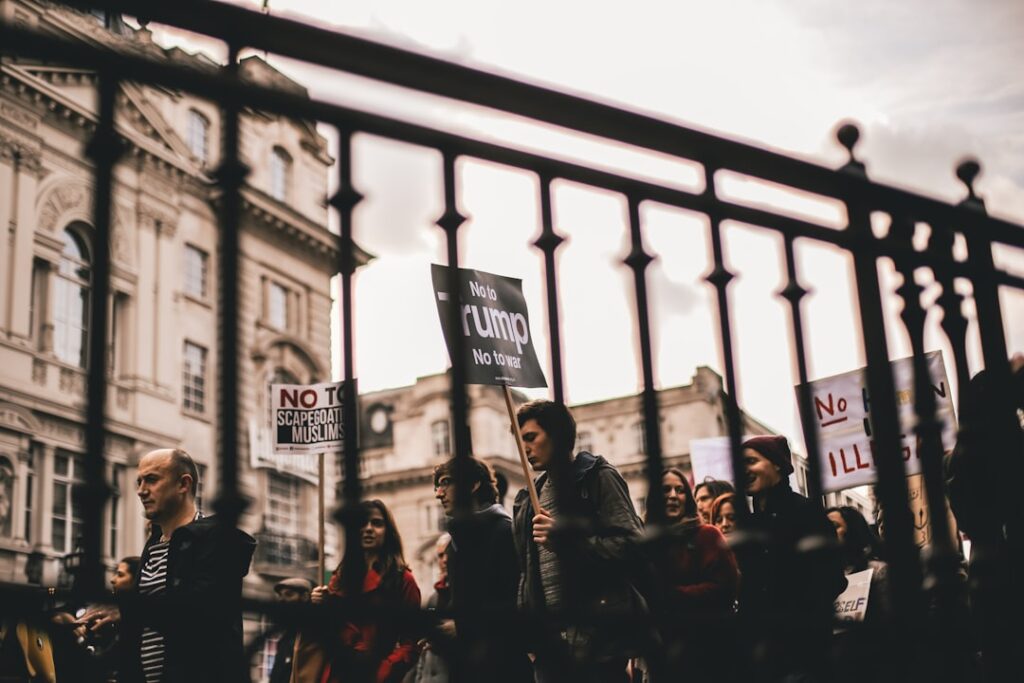
Image: GlobalBeat / 2026
Trump protests today: Millions march in ‘No Kings’ rallies across 400 US cities
Muhammad Asghar | GlobalBeat
Organizers reported 3.2 million Americans demonstrated against President Donald Trump on Saturday in coordinated “No Kings” protests spanning all 50 states.
The crowd count surpassed the previous largest anti-Trump demonstration by 800,000 people, according to University of Connecticut crowd science professor Eric Chen, who analyzed aerial footage from 37 major cities.
The protests erupted after Trump’s March 27 executive order expanding presidential emergency powers and his televised statement that “the people elected a king, not a puppet.” Demonstrators carried gold-painted cardboard crowns covered in red X’s and chanted “no kings, no tyrants” outside state capitols from Maine to Hawaii.
Crowds began forming at 9 a.m. in Boston Common where 75,000 people braved 38-degree rain. By noon, Philadelphia’s Benjamin Franklin Parkway held 180,000 protesters, causing SEPTA to suspend all downtown bus routes. Chicago police closed Lake Shore Drive after 250,000 people packed Grant Park, spilling onto Columbus Drive.
“It’s bigger than Women’s March 2017,” said Denver Police Commander Maria Rodriguez as 90,000 people surrounded the Colorado State Capitol. “We’ve never seen these numbers for a single cause.”
The decentralized protests lacked a national leader but shared three demands posted on social media: repeal Trump’s emergency powers expansion, restore fired inspectors general across federal agencies, and end what organizers call “presidential rule by decree.”
Republican National Committee spokesperson Brian Hughes dismissed the demonstrations in a statement: “These are sore losers who can’t accept President Trump’s decisive 2024 mandate. The American people want results, not resistance.”
Counter-protesters appeared in limited numbers. In Phoenix, 300 Trump supporters held a separate rally 2 miles away from the 65,000-person anti-Trump crowd. Two men were arrested after a scuffle near the Arizona Capitol, state police confirmed.
The largest single gathering occurred in Washington where 450,000 people filled the National Mall, stretching from the Capitol Reflecting Pool to the Lincoln Memorial. Transportation Secretary Sean Daly said Metro recorded its highest Saturday ridership since Barack Obama’s 2009 inauguration.
House Minority Leader Hakeem Jeffries addressed the Washington crowd: “This republic belongs to the people, not any man who thinks himself king.” Senator Elizabeth Warren told Boston protesters: “We fired King George in 1776. We’ll fire wannabe King Donald in 2026.”
Protesters cited Trump’s growing list of executive actions since January. The president has signed 47 executive orders, compared to 12 by this point in his first term. His March orders fired 14 inspectors general, imposed 20% tariffs on Chinese goods, and directed federal agencies to “prioritize presidential directives over congressional appropriations.”
“Congress won’t stop him,” said Sarah Kim, 34, who brought her two children to the Los Angeles rally. “The courts won’t stop him. It’s up to us.”
Trump spent Saturday at his Mar-a-Lago resort in Florida. The White House released a photo of the president playing golf at 2:17 p.m. with the caption: “Working hard for the American people.” Senior adviser Stephen Miller told reporters aboard Air Force One: “President Trump is focused on delivering for hard-working families, not the radical left’s temper tantrums.”
The demonstrations remained largely peaceful. Police reported 34 arrests nationwide, mostly for disorderly conduct. In Portland, Oregon, three people suffered minor injuries when a pickup truck drove through a crosswalk where 20,000 protesters marched. The driver was arrested for reckless driving.
International attention focused on the protests. German Chancellor Friedrich Merz tweeted: “The strength of American democracy is measured by its people’s ability to speak freely.” Chinese state media called the protests “evidence of American decline” while Russian television featured footage of traffic jams with captions reading “USA in chaos.”
The White House Correspondents’ Association noted that Trump made no public appearances Saturday, breaking the 42-year tradition of presidents acknowledging major protests. Press secretary Karoline Leavitt’s only comment came via Truth Social: “Fake news media exaggerates crowd sizes again.”
Background
Mass protests against American presidents trace back to 1969 when 250,000 people marched against Richard Nixon’s Vietnam War policies. The largest single-day protest remains the 2017 Women’s March, which drew 4.2 million people the day after Trump’s first inauguration.
Trump faced regular demonstrations during his 2017-2021 term, most notably over family separation policies at the southern border and the Supreme Court confirmation of Brett Kavanaugh. Saturday’s protests exceeded any single day of resistance during his first term.
The “No Kings” rallying cry emerged from Trump’s March 22 rally in Green Bay, Wisconsin, where he told supporters: “I am your justice. I am your retribution. I answer to nobody but you.” The phrase trended on social media within hours, with anti-Trump groups adopting it as their banner.
What’s Next
Organizers announced “No Kings 2.0” protests for April 19, targeting state legislatures during their budget sessions. They’re demanding governors invoke the 25th Amendment if Congress won’t act. Republican strategists warn continued demonstrations could energize GOP voters for the 2026 midterms, while Democratic officials privately worry about protest fatigue setting in before next year’s elections.
The demonstrations signal a potential constitutional crisis brewing between Trump’s expansive view of executive power and traditional checks and balances. Watch for whether Republicans in Congress break ranks as protests continue, particularly senators facing re-election in purple states next year. The real test comes when Trump’s expanded emergency powers face their first legal challenge, expected this week when environmental groups sue over his March 28 order approving oil drilling in national monuments.
Senior Correspondent, World & Geopolitics
Muhammad Asghar covers international affairs, conflict zones, and US foreign policy for GlobalBeat. He has reported on events across the Middle East, South Asia, and Eastern Europe, with a focus on the intersection of diplomacy and armed conflict. He has been writing wire-service journalism for over a decade.