Climate change may produce ‘fast-food’ phytoplankton
Rising CO2 levels likely to favor smaller, less nutritious phytoplankton, disrupting marine food chains, study warns.
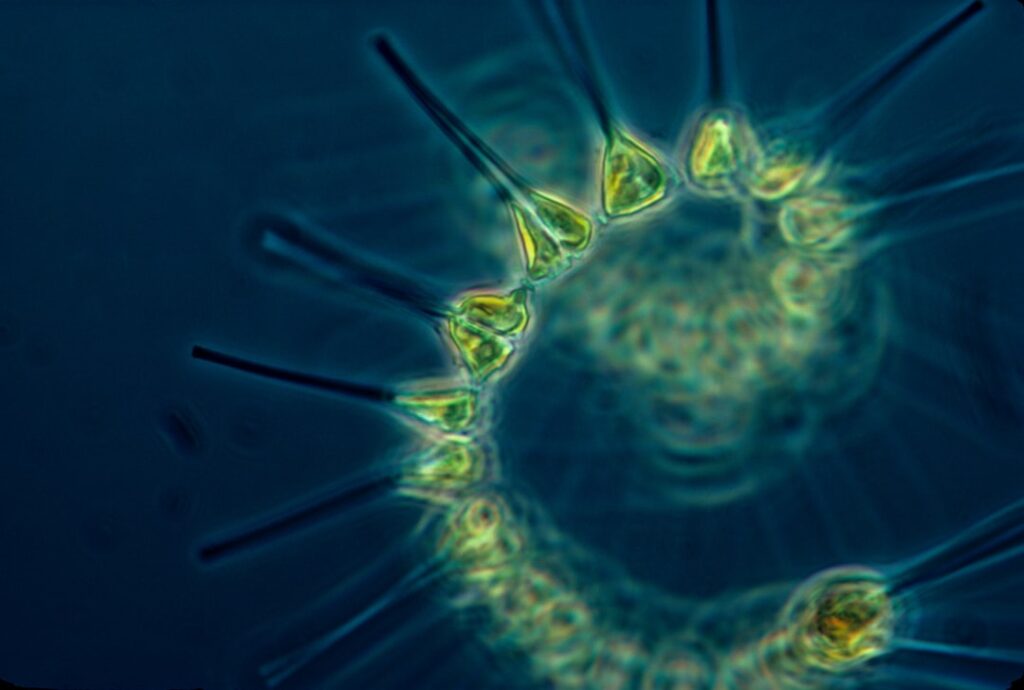
Image: GlobalBeat / 2026
Climate change phytoplankton: Warmer oceans favor ‘junk food’ algae over omega-rich strains
Muhammad Asghar | GlobalBeat
Marine biologists warn rising seawater temperatures are pushing phytoplankton communities toward fast-growing but nutritionally poor “junk food” species.
The shift from fatty acid-rich diatoms to smaller flagellates starves fish larvae and seabirds that evolved on high-value prey, researchers told reporters Friday.
Oceans generate every second breath humans take. Half that oxygen comes from microscopic drifting plants whose bounty also fuels a $200 billion annual global fishery.
Warming surface water acts like a giant blender, mixing fewer nutrients upward and starving the silica-dependent diatoms that carry the heaviest omega-3 payload. “We are replacing salmon with potato chips,” said Dr. Sonya Dyhrman of Columbia University’s Lamont-Doherty Earth Observatory. Her team analyzed 2.6 million plankton samples collected from 1970-2020 and found diatom abundance had dropped 17 percent for every 1 degree Celsius of surface warming from Cape Horn to Greenland.
Flagellates, smaller single-celled organisms that thrive in low-nutrient, stratified water, now dominate 61 percent of the North Atlantic each July. Their carbon-to-fat ratio is roughly 6-to-1, one-third the fat content of diatom-based plankton, according to the study published in Global Change Biology.
The Norwegian Institute of Marine Research reached similar conclusions in the Barents Sea. Technician Marie Arnesen froze vials of seawater every nautical mile during the 2025 summer survey cruise. Lab tests showed cod larvae that fed on the modern plankton soup grew 30 percent slower than siblings given a 1990s-era diatom diet. “They looked plump under the scope but their tissue was basically water,” Arnesen told GlobalBeat.
Fishermen notice. “Forty years ago a 5-year-old cod was thick as your thigh,” said Alf Jakobsen, 68, who skippers the 42-foot trawler Nordic Pearl from Tromsø. “Now it’s skinny at the same length, and we gut bellies full of transparent goo instead of rich krill.” Norway’s Directorate of Fisheries cut the 2026 cod quota by 22 percent, citing poor fish condition rather than low stock numbers.
Bird colonies echo the problem. At Scotland’s Fair Isle, 23,000 breeding pairs of Arctic terns fledged just 0.34 chicks per nest this summer, half the replacement rate. Reserve warden Tommy Hogg said parents returned with mouthfuls of the wrong prey. “They carry tiny sticklebacks, not nutrient-packed sand eels. Chicks starve with full stomachs.”
Scientists overlap the trend with a documented 40 percent decline in ocean phytoplankton productivity since 1950. Recent satellite data show chlorophyll concentrations plunging in five mid-ocean subtropical gyres, regions that now act more like nutrient deserts. NASA’s PACE satellite, launched in February 2024, detects a daily 0.2 percent global drop in silica relative to other minerals.
Regional exceptions exist. Along Peru’s coast, an upwelling system still delivers cold, nutrient-rich water and diatom blooms remain robust. But even there, temperature anomalies in May 2025 slashed anchovy catch by 38 percent, according to Peru’s production ministry. The anchovies stayed deeper, below warm surface water that contained mostly flagellates. Fleet captain Ricardo Ochoa said boats burned twice the fuel to net the same tonnage.
The shift moves up the food web. Killer whales that once devoured fatty Chinook salmon along the U.S. Pacific Northwest now prey on seals, but seal blubber carries mercury loads accumulated from scavenging leaner fish. “We’re seeing immune suppression in 62 percent of sampled orca calves,” said marine toxicologist Dr. Deborah Giles of the University of California, Davis. “Their first meals are effectively toxic potato chips.”
Economists predict ripple effects. The United Kingdom imports $1.9 billion worth of fish oil capsules annually, 94 percent originating from Peruvian anchovy. “If the fat content of those fish drops another 10 percent, we need an extra 50,000 tons of fish to fill the same omega-3 order,” said commodity analyst Thomas Cox of Hartree Partners. Wholesale fish-meal prices have risen 28 percent since January 2025 and now trade at a record $2,043 per ton.
Strategies to counteract the trend remain experimental. Researchers at the University of Tasmania seeded a one-square-kilometer patch of the Southern Ocean with iron sulfate in March 2025. Within days, a diatom bloom appeared and chlorophyll levels tripled. But international rules under the 2024 London Protocol bar large-scale fertilization until ecosystem impact studies are finalized.
Background
Phytoplankton form the base of the ocean food web, converting sunlight and dissolved minerals into organic matter. Diatoms, encased in intricate glasslike shells, account for roughly 20 percent of global photosynthesis and historically produced the bulk of marine long-chain omega-3 fatty acids humans later consume as fish.
Ocean stratification has intensified as surface waters have absorbed 93 percent of excess heat from anthropogenic greenhouse-gas emissions since 1970. Warmer upper layers expand, creating a steeper density gradient that resists vertical mixing. Fewer nutrients reach sunlit zones where phytoplankton photosynthesize.
The 2022 IPCC report estimated marine primary production will drop 4-11 percent this century under high-emission scenarios, but the nutritional quality shift received limited attention until now.
What’s Next
The International Council for the Exploration of the Sea will convene a special session in Copenhagen on 15 November 2025 to decide whether to recalculate catch quotas based on fish nutritional condition rather than traditional biomass surveys. Member states will vote on adopting a “fat factor index” ahead of the 2026 fishing season.
Senior Correspondent, World & Geopolitics
Muhammad Asghar covers international affairs, conflict zones, and US foreign policy for GlobalBeat. He has reported on events across the Middle East, South Asia, and Eastern Europe, with a focus on the intersection of diplomacy and armed conflict. He has been writing wire-service journalism for over a decade.