MCCC opens new Health Sciences Simulation Center
Montgomery County Community College opened its new Health Sciences Simulation Center to train nursing and allied health students with advanced patient simulators.
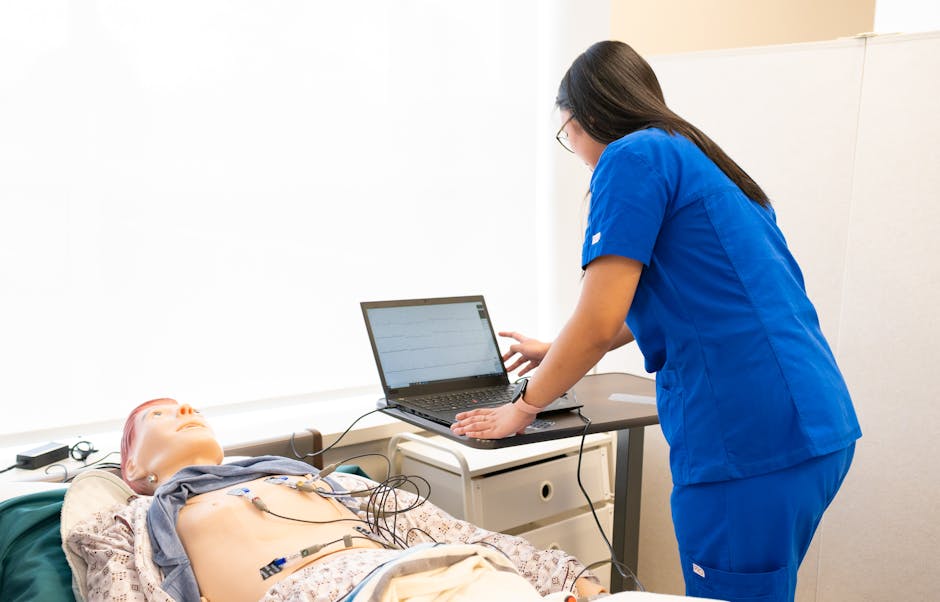
Image: GlobalBeat / 2026
Healthcare simulation center opens at MCCC with $2.3 million in new tech
Sarah Mills | GlobalBeat
Montgomery County Community College debuted its Health Sciences Simulation Center on Thursday, a 6,000-square-foot facility designed to mimic hospital wards, emergency rooms and patient homes.
The center houses 18 high-fidelity mannequins that bleed, breathe and give birth, plus a fully equipped ambulance bay and a two-room apartment for home-health training.
Nursing enrollment has climbed 35 percent since 2021, squeezing existing labs and forcing some students to travel to partner hospitals for basic simulations. The new space replaces a 1980s-era lab that could handle 8 students at once; the new setup allows 48.
“We were turning students away,” MCCC president Victoria Bastecki-Perez told reporters during a ribbon-cutting. “This building lets us add 70 nursing seats next fall and, for the first time, run a evening cohort for working parents.”
The college financed the $2.3 million project with state grants, federal pandemic relief and a $500,000 gift from the Montgomery County Hospital System. Private donors chipped in another $300,000 for specialized pediatric and obstetric simulators that can prezsent seizures or post-partum hemorrhage on command.
Inside the center, second-year nursing student Jada Mensah practiced inserting an IV into a talking mannequin whose arm skin feels human. When she missed the vein, the arm bruised and the mannequin yelped. An instructor tapped a tablet to reset the tissue.
“You get the adrenaline rush here, not on a real patient,” Mensah said. “I can mess up, learn, and try again.”
A control room lined with one-way glass lets faculty script scenarios ranging from routine births to mass-casualty shootings. Speakers pipe in ambulance sirens, crying babies or family arguments. Faculty can speak through the mannequins or play the voice of a distraught relative.
Emergency medical technician students will share the space, marking the first time MCCC runs nursing and EMT simulation together. County fire officials said the collaboration should shorten the timeline between certification and employment for paramedics, a field facing 18 percent vacancy rates across southeastern Pennsylvania.
Construction crews broke ground in March 2025 after the college scrapped plans for a smaller renovation. Supply-chain snarls delayed delivery of a $180,000 neonatal mannequin for three months, pushing the opening from January to late March.
The wait irritated some students who finished coursework but delayed graduation to log required simulation hours. “I had a job offer contingent on finishing my pediatric rotation,” said EMT candidate Luis Ortega. “This place finally lets me graduate.”
Local hospitals stand to benefit. Einstein Medical Center Montgomery, four miles south, signed an agreement to send new hires to the center for quarterly competency drills instead of flying trainers to Baltimore. The hospital estimates the switch will save $90,000 a year.
“We can rehearse rare events like eclampsia or Code Blue in pediatrics without risking actual patients,” Einstein chief nursing officer Karen Wilson said. “That translates to lower malpractice premiums and better outcomes.”
The center also cements MCCC’s role in a regional healthcare workforce pipeline that stretches from high school dual-enrollment programs to bachelor’s degree partnerships with Jefferson and Temple universities. Governor Josh Shapiro’s administration has set a goal of adding 2,500 new nurses across Pennsylvania by 2028; MCCC’s expansion covers roughly 5 percent of that target.
High schoolers will get access too. Starting this fall, 50 students from Norristown Area High can earn college credit by spending one afternoon a week in the apartment lab, learning to monitor blood pressure and glucose in elderly volunteers recruited from a nearby senior center.
Critics question whether the investment matches long-term demand. Pennsylvania’s nurse workforce rebounded after pandemic departures, and some hospital systems have slowed hiring. But state labor data still projects a 12 percent shortfall by 2030 as aging nurses retire.
“We’re building for the exit wave, not the current dip,” Bastecki-Perez countered, citing average nurse age of 52 in Montgomery County.
Background
MCCC launched its first associate-degree nursing track in 1968 inside a converted Kar-Kraft auto plant the college rented in Blue Bell. The program graduated 23 students that year. Enrollment stayed flat for decades until the Affordable Care Act expanded insurance coverage, spurring hospital hiring. Between 2014 and 2021 applications doubled, but lab space did not, creating the bottleneck the new center is designed to ease.
Simulation-based education itself has shifted from simple plastic models to computer-driven mannequins that store electronic health records. A 2022 review by the National Council of State Boards of Nursing found that up to 50 percent of traditional clinical hours can safely be replaced by simulation without harming patient outcomes, a finding that emboldened MCCC to expand seat capacity even without immediate hospital preceptor slots.
What’s Next
The college will seek accreditation from the Society for Simulation in Healthcare by December, a credential that would let it market the lab to commercial medical-device companies for product training. Pending approval, administrators plan weekend courses in IV sedation for dental assistants and certification refreshers for airline cabin crews, revenue streams that could offset operating costs estimated at $400,000 a year.
The first cohort of 70 additional nursing students starts in August, and administrators will track whether simulation-heavy training reduces first-time NCLEX pass rates. Early data from pilot groups shows a 94 percent pass rate, three points above the state average. If results hold, MCCC trustees have green-lit a second-phase expansion that would add a surgical robotics suite by 2028.
Technology & Science Editor
Sarah Mills is GlobalBeat’s technology and science editor, covering artificial intelligence, cybersecurity, public health, and climate research. Before joining GlobalBeat, she reported for technology desks across Europe and North America. She holds a degree in Computer Science and Journalism.