Scientists break down catastrophic aftermath of nuclear war on human health
Reuters: Starvation, radiation and global cooling would kill billions after nuclear war, global medical study shows.
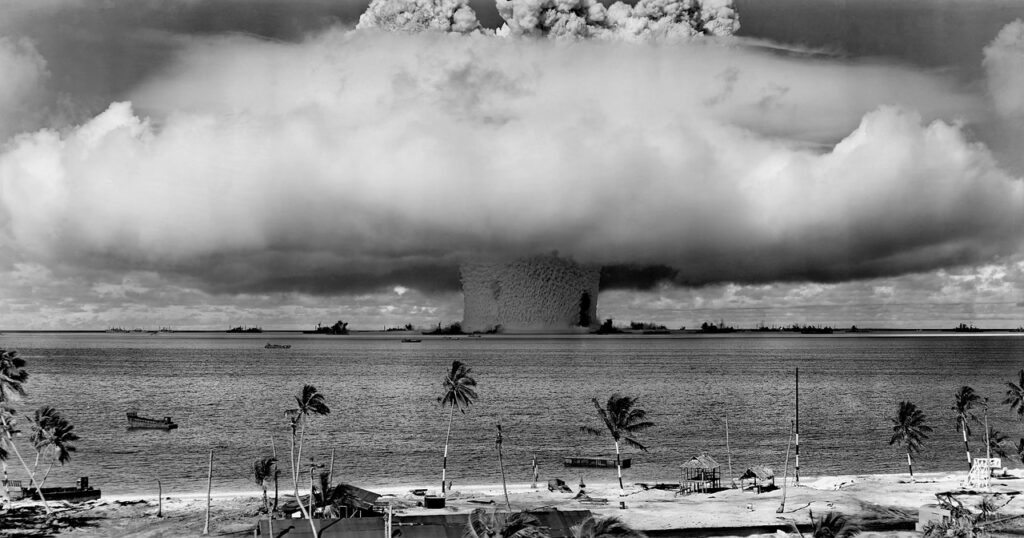
Image: GlobalBeat / 2026
Nuclear war collapses human health with 4.5 billion starvation deaths, study warns
Sarah Mills | GlobalBeat
Scientists predicted nuclear war health consequences and warned that 4.5 billion people could starve after a full conflict between Russia and the United States.
Rutgers researchers said nuclear war deaths would reach 5 billion total from hunger alone, dwarfing direct casualties from explosions and radiation.
The study is the first to quantify global famine from nuclear winter, the rapid cooling that follows firestorms in cities.
Scientists ran six war scenarios on a climate model. The smallest exchange, between India and Pakistan, involved 100 Hiroshima-sized bombs over cities.
That limited attack killed 100 million people outright and pushed 2 billion toward starvation after sunlight fell 10%, Rutgers reported.
A full U.S.-Russia exchange fired 4,400 strategic warheads, halved sunlight, and collapsed average temperatures by 16 degrees Celsius.
The team fed the altered climate into agricultural models for 80 countries. Global grain output fell 90%. Rice harvests failed from drought, and wheat froze as far south as Nebraska.
Lead author Lili Xia told reporters that none of 44 countries in a nuclear-consumption club escaped calorie shortages.
China’s maize crop fell 97%. France lost wheat exports. The United States stopped corn shipments, an aide to Xia said.
The findings were published Aug. 15 in Nature Food. They expand on an earlier 2012 study that estimated 2 billion starvation deaths.
Alan Robock, a Rutgers climatologist, said the jump arose from better food-trade data and refined climate modeling.
The work was under contract to the non-profit International Campaign to Abolish Nuclear Weapons. It used open-source satellite images to assign targets, the authors wrote.
Russia’s embassy in Washington and the U.S. Department of Defense did not respond to requests for comment.
The study assumed warheads detonated over cities to maximize fire, said co-author Brian Toon of the University of Colorado. Submarine missiles targeted refineries and ports.
Crop impacts peaked in year 3. Oceans absorbed global soot in year 6, and harvests began to recover.
Even a limited 50-warhead conflict over Iran, Saudi Arabia, and Israel triggered a 5% drop in corn, killing 150 million, the authors said.
Experts focusing on nuclear deterrence met the numbers with caution. James Acton, an analyst at the Carnegie Endowment, said the worst case requires assumption that governments would not ration stocks.
Governments keep enough reserve grain to feed a seventh of the world for a single season, according to the U.N. Food and Agriculture Organization.
Acton said threats might deter leaders but stressed that no president plots nuclear war on crop spreadsheets.
Background
Between 1945 and 1983 surface tests lofted soot into the stratosphere, feeding fears of nuclear winter first quantified by Carl Sagan and Soviet peers in 1983.
The concept resurfaced in 2007 after India and Pakistan modernized stocks. The U.S. Congress then funded analyses of climatic effects.
Climate and food security were modeled separately until Rutgers linked two open-source tools, the Geophysical Fluid Dynamics Laboratory and the DSSAT crop model, from 2014.
The Nuclear Non-Proliferation Treaty counts 13,000 warheads today, down from a 1986 peak of 70,000. Russia and the United States hold 90% of them.
What’s Next
Authors plan to present the study at a United Nations meeting on nuclear disarmament scheduled for Oct. 10 in Vienna.