US says blockade of Iran’s ports will start within hours
U.S. announces imminent naval blockade on Iranian ports, citing national security concerns.
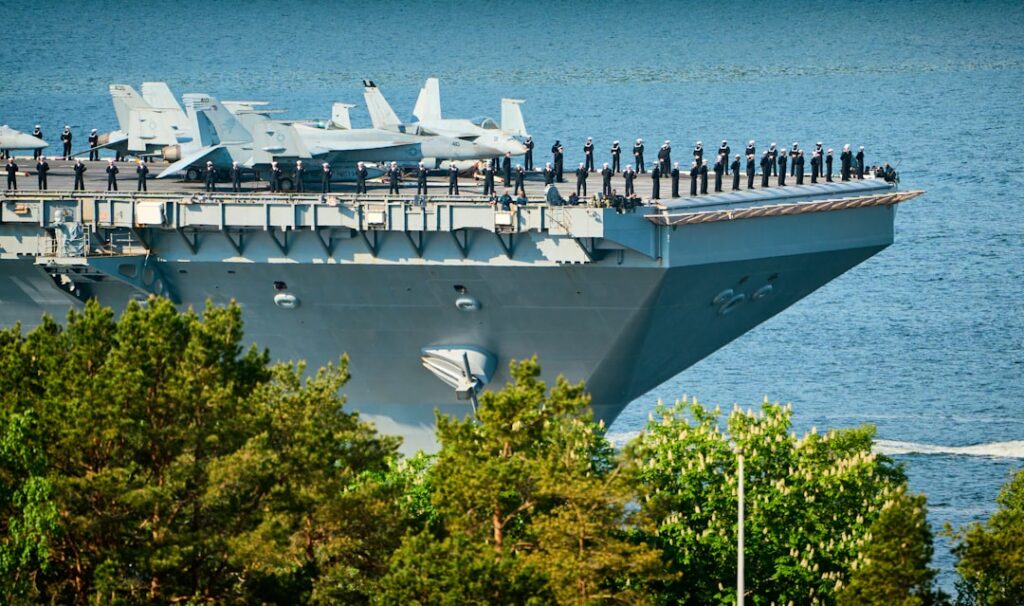
Image: GlobalBeat / 2026
US Iran blockade: American warships seal Persian Gulf ports within hours
Muhammad Asghar | GlobalBeat
The United States Navy began deploying warships to blockade Iranian ports in the Persian Gulf on Saturday, with Defense Secretary Pete Hegseth announcing the operation would be fully active “within hours.”
Hegseth told reporters at the Pentagon that the blockade targets all commercial shipping to and from Iran’s primary oil terminals at Kharg Island, Bandar Abbas, and Bandar-e Mahshahr. The move comes after President Donald Trump authorized what he called “maximum economic pressure” against Tehran.
Iran depends on maritime trade for 80 percent of its oil exports, which generate roughly $50 billion annually and fund the government’s operations. The Islamic Republic’s economy already contracted 4 percent last year under existing sanctions, according to International Monetary Fund data.
The Pentagon released satellite imagery showing the aircraft carrier USS Harry S. Truman and three destroyers taking positions near the Strait of Hormuz, the narrow waterway through which one-fifth of global oil supplies pass. Hegseth said the ships would intercept and board any vessels suspected of carrying Iranian oil.
Initial reports from maritime traffic trackers showed at least 12 tankers changing course away from Iranian waters within the first 90 minutes of the announcement. Oil prices jumped 8 percent on the news, with Brent crude trading above $95 per barrel for the first time since October.
Iranian Foreign Minister Abbas Araghchi condemned the blockade as “an act of piracy” in a statement carried by state media. “The United States has declared economic war on the Iranian people,” Araghchi said, warning that Tehran would respond with “all available means.”
The Islamic Revolutionary Guard Corps placed its naval forces on high alert, according to the semi-official Tasnim news agency. Small fast-attack boats typically used by the IRGC Navy were seen conducting patrols near Iran’s coastline, though no direct confrontations were reported.
China, the largest buyer of Iranian oil, expressed “serious concern” about the American action. Foreign Ministry spokesperson Lin Jian told reporters in Beijing that Washington’s unilateral sanctions violate international law and threaten regional stability. China imported approximately 1.2 million barrels per day from Iran last month.
European allies offered more measured responses. British Foreign Secretary David Lammy said London supports “targeted economic measures” but urged Washington to avoid actions that could disrupt commercial shipping for other nations. Germany’s foreign office issued a similar statement calling for “maximum restraint.”
The blockade represents a dramatic escalation of Trump’s “maximum pressure” campaign against Iran. During his first term, the president withdrew from the 2015 nuclear deal and imposed sanctions that cut Iranian oil exports from 2.5 million barrels daily to less than 300,000.
Previous sanctions already forced Iran to rely on shadowy tanker networks that turn off tracking devices and transfer oil ship-to-ship to disguise its origin. Analysts say these methods will become more difficult under a physical naval blockade that can intercept vessels directly.
The American naval presence creates immediate risks for commercial shipping in the crowded waterway. Lloyd’s List Intelligence reported that 2,000 vessels pass through the Strait of Hormuz each week, carrying cargo worth approximately $1.2 billion daily.
Insurance markets reacted swiftly to the heightened tensions. War risk premiums for vessels operating in the Persian Gulf surged 400 percent, according to the Baltic and International Maritime Council. Several major shipping companies immediately suspended new bookings for Iranian routes.
Background
The United States and Iran have engaged in escalating tensions since Trump withdrew from the Joint Comprehensive Plan of Action nuclear agreement in 2018. That deal, negotiated under former President Barack Obama, had lifted sanctions in exchange for limits on Iran’s nuclear program.
After the withdrawal, Trump imposed sanctions targeting Iran’s oil exports, banking sector, and shipping industry. The measures caused Iran’s economy to shrink by one-third and sent inflation above 40 percent, according to World Bank figures. Tehran responded by gradually violating the nuclear deal’s restrictions while denying any intention to build weapons.
Naval confrontations in the Persian Gulf have occurred periodically for decades. In 2019, the IRGC seized a British-flagged tanker in apparent retaliation for Gibraltar detaining an Iranian vessel. The United States also killed IRGC commander Qasem Soleimani in a 2020 drone strike, bringing both nations to the brink of direct conflict.
What’s Next
The Pentagon said the blockade would continue indefinitely until Iran agrees to new negotiations on its nuclear program and regional activities. Hegseth indicated Washington might expand the operation to include Iran’s Caspian Sea ports if Tehran retaliates against American forces or allies.
Senior Correspondent, World & Geopolitics
Muhammad Asghar covers international affairs, conflict zones, and US foreign policy for GlobalBeat. He has reported on events across the Middle East, South Asia, and Eastern Europe, with a focus on the intersection of diplomacy and armed conflict. He has been writing wire-service journalism for over a decade.