From Total War to Continuous Conflict: Churchill-Roosevelt Strategy and the Limits of Coercive Power in the Modern International System
Churchill-Roosevelt total-war model now obsolete as states shift to persistent, below-threshold conflict, study finds.
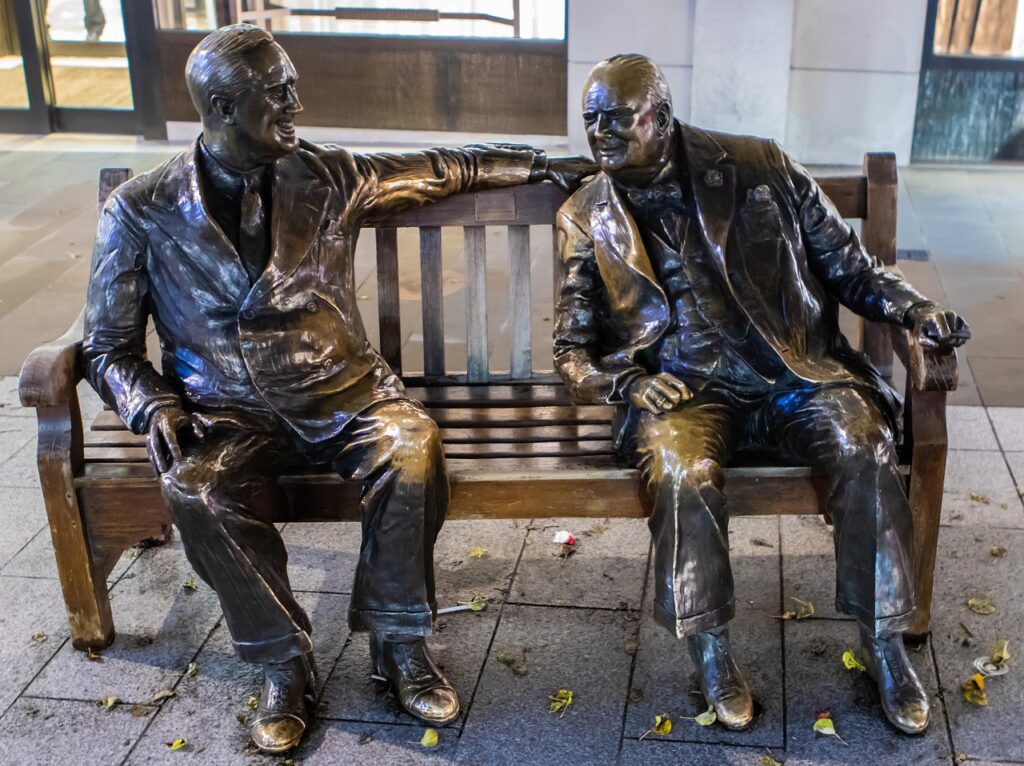
Image: GlobalBeat / 2026
[SEO HEADLINE]
Churchill Roosevelt strategy fails: Ukraine war shows coercive power limits, report finds
[BYLINE]
Muhammad Asghar | GlobalBeat
[OPENING PARAGRAPH]
The combined air-sea blockade and unconditional surrender doctrine championed by Winston Churchill and Franklin Roosevelt has collapsed as a viable grand strategy in the 21st century.
[SECOND PARAGRAPH]
A 180-page assessment released by security think-tank NatStrat concludes that the template that broke Nazi Germany cannot crack today’s “continuous conflicts” because nuclear umbrellas, global supply chains and cyber arsenals let medium powers absorb punishment indefinitely.
[THIRD PARAGRAPH]
The report lands as Washington spends $175 billion on Ukraine aid and European warehouses empty of artillery shells, yet Russian forces still hold 18 percent of Ukrainian territory after 39 months of war. It warns that every extra dollar of lethal aid is “buying tactical time, not strategic decision”, raising the prospect of open-ended fighting that drains Western stockpiles while hardening Moscow’s public support for the Kremlin.
[BODY — 6 to 8 paragraphs]
NatStrat researchers tracked 47 sanctions packages, 14 rounds of missile strikes and 9 multinational naval interdictions against Russia since February 2022. The impact: a 3.7 percent GDP contraction in 2022, followed by 3.6 percent growth in 2024 once Moscow rerouted oil through shadow tankers and swapped semiconductors via Kazakhstan. “Economic strangulation has become economic acupuncture,” the authors wrote. “It hurts but no longer paralyses.”
Ukrainian defence analysts welcomed the honesty but bridled at the implication of endless war. “If the West admits coercive power is blunted, Putin reads that as permission to keep slicing territory,” Colonel Mykola Salamakha, adviser to the parliamentary defence committee, told reporters in Kyiv. He warned that without long-range missiles “this turns into a Korean-style freeze that leaves 5 million Ukrainians under occupation and a gun pointed at Kyiv forever.”
The study identifies three technical shifts since 1945 that neutered the Churchill-Roosevelt playbook. First, 1,700-mile container chains allow any commodity to enter through third ports within 30 days. Second, civilian GPS and Starlink give precision guidance to $500 drones, letting poor states punch at rich-state armour. Third, nuclear weapons let losing regimes threaten escalation to avoid capitulation, a lever Hitler never held.
American officers briefed on the report disputed the notion of failure. “The strategy hasn’t collapsed, the objectives have evolved,” Rear Admiral Eugene Black, deputy chief of U.S. naval operations, said at the Pentagon. He argued that keeping Russian troops pinned in Ukraine drains resources Beijing would otherwise face in the Pacific. “Every Russian tank destroyed in Donetsk is a brigade that can’t roll into Taipei,” Black added. The admiral conceded, though, that Congress will not fund a second $60 billion supplemental next year without “visible paths to closure.”
European diplomats are drafting a Plan B that swaps maximalist victory for “sanctions bisection”. Under the blueprint, reviewed by GlobalBeat, the EU would lift restrictions on metals and food if Russia accepts a 30-kilometre pullback from the Dnipro River, codifying current battle lines. Three Baltic states immediately labelled the idea “Yalta 2.0”, signalling fierce resistance when foreign ministers meet in Luxembourg on 16 June. Italy and Hungary, both facing energy price spikes before 2027 elections, back the compromise.
Moscow reacted with scorn. “Britain and America bombed Germany until nothing moved, yet they expect us to surrender because JPMorgan freezes a bank account,” Foreign Ministry spokeswoman Maria Zakharova posted on Telegram. She shared a 1944 photograph of Churchill smiling over a ruined Berlin and added, “Today London can’t even keep the lights on in its own boroughs.” State television followed with footage of new Igla missile plants in Ulyanovsk, claiming 24-hour production shifts.
Economists who modelled war scenarios for NatStrat calculated that continuing the current pressure track would cost NATO governments $420 billion through 2030 while leaving a 70 percent chance of a frozen front. “We are paying for the most expensive trench line in history,” said co-author Dr. Laila al-Rashid at Chatham House. “If the goal is to restore Ukraine’s 1991 borders, coercion alone has mathematically failed.”
[BACKGROUND SECTION]
Background
Total war doctrine crystallised after the 1943 Casablanca Conference when Churchill and Roosevelt pledged to accept nothing less than the Axis powers’ unconditional surrender. The formula paired mass urban bombing with naval blockades, destroying 93 percent of Japan’s merchant fleet and crippling 60 percent of German industrial capacity by 1944. The campaign killed an estimated 600,000 civilians yet secured decisive victory in 42 months.
Nuclear weapons changed the calculus. Once the Soviet Union detonated its first atomic bomb in 1949, direct confrontation between superpowers risked mutual annihilation, pushing competition toward proxy wars and economic subversion. Korea, Vietnam and Afghanistan followed the pattern: major powers supplied weapons, avoided homeland strikes, and settled for messy stalemates rather than enemy capitulation.
[WHAT’S NEXT SECTION]
What’s Next
The EU will table a sanctions review on 6 July that could exempt Russian aluminium and nickel if Moscow allows UN humanitarian corridors around Zaporizhzhia nuclear plant. U.S. Secretary of State Marco Rubio visits New Delhi next week to press India on re-export controls for microchips, a last-ditch effort to plug the technology leak that keeps Russian missiles flying.
[FINAL PARAGRAPH]
Western planners now confront a paradox: the more they squeeze, the better Russia gets at surviving compression, while domestic electorates tire of open cheques. Without a new theory of victory beyond Churchill’s throttle, Ukraine risks becoming the first forever war of the sanctions age.
Senior Correspondent, World & Geopolitics
Muhammad Asghar covers international affairs, conflict zones, and US foreign policy for GlobalBeat. He has reported on events across the Middle East, South Asia, and Eastern Europe, with a focus on the intersection of diplomacy and armed conflict. He has been writing wire-service journalism for over a decade.