Iran War Live Updates: Crucial E-3 Sentry Aircraft Damaged in Saudi Base Attack
U.S. E-3 Sentry surveillance aircraft damaged in Iranian missile strike on Saudi base, officials confirm.
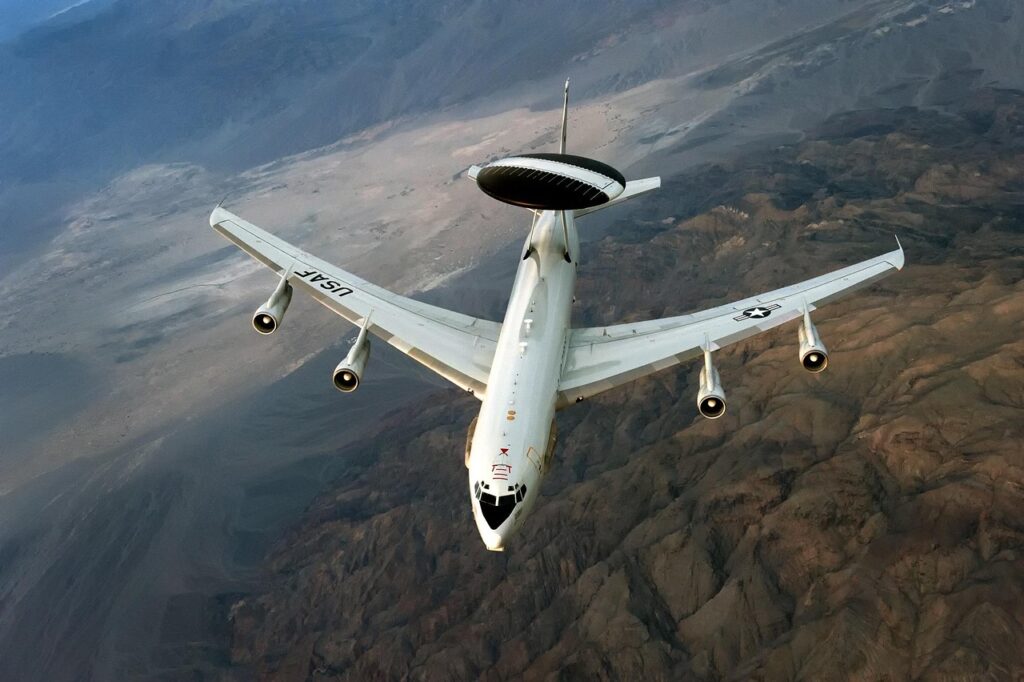
Image: GlobalBeat / 2026
Iran war: E-3 Sentry spy plane hit in Saudi base missile strike
Muhammad Asghar | GlobalBeat
An Iranian missile barrage damaged a U.S. Air Force E-3 Sentry surveillance aircraft at Prince Sultan Air Base in Saudi Arabia overnight, marking the first confirmed strike on American military hardware since hostilities erupted.
The airborne warning and control system plane, valued at $270 million, suffered shrapnel wounds to its radar dome and fuselage, U.S. Central Command confirmed.
The attack signals Tehran’s widening target list after a week of strikes limited to Israeli and Gulf energy sites, raising the stakes for Washington which has 45,000 troops across the region. Riyadh had stayed on the sidelines until Sunday, when debris from intercepted drones killed 2 civilians in the Eastern Province.
Fragments punched 6 holes through the AWACS radome while fuel lines feeding its 4 turbofan engines were severed, Capt. Patricia Allen told reporters at the desert base 90 km south of Riyadh. Ground crew doused a small fire on the starboard wing. No Americans were wounded, but the aircraft is “mission-incapable” pending depot-level repairs likely to take months, she added.
The damage leaves U.S. planners with only 2 other Sentries in the Middle East, down from the usual 4 that stitch together an airborne radar net over the Persian Gulf. Normal patrols resume Monday with Nato E-3As flying from Crete to plug gaps, Allen said.
Saudi air defenses intercepted 18 of 22 ballistic missiles fired early Monday, state media said. Debris rained on oil facilities in Ras Tanura and a desalination plant in Jubail, halting production at both sites for “security checks”, energy minister Prince Abdulaziz bin Salman announced. Brent crude jumped 4% to $95.70 a barrel on the news.
Iran’s Revolutionary Guards claimed the salvo targeted “U.S. strategic hubs” that provide “satellite guidance to Zionist bombers”. They warned Saudi Arabia against “hostile tolerance” of American forces on its soil. The kingdom hosts 3,000 U.S. personnel at Prince Sultan and 2,000 at Eskan Village near Riyadh.
President Trump convened an emergency National Security Council meeting at 0200 Washington time, the White House said. He authorized deployment of extra Patriot batteries to the kingdom but vetoed strikes inside Iran proposed by some aides, according to 2 officials familiar with the discussion.
Riyadh stopped short of blaming Tehran directly, calling instead for “maximum restraint” in a foreign ministry statement. The measured wording reflects Saudi efforts to avoid direct confrontation after 2019 attacks on Abqaiq that briefly halved its oil output and were pinned on Iran.
Gulf markets tanked. The Saudi Tadawul index slid 5.1% in early trade, wiping $70 billion off share values. Aramco stock fell 7%. Kuwait and Abu Dhabi bourses triggered circuit breakers. Asian refineries scrambled for spot cargoes, pushing the Dubai benchmark premium to 5-year highs.
Houthi rebels in Yemen lauded the Iranian raid and pledged parallel drone strikes on Saudi infrastructure. The group, which Riyadh has fought since 2015, fired 2 missiles toward Jazan late Monday; both were intercepted, coalition spokesperson Brig. Gen. Turki al-Malki said.
Background
Tensions ignited on 18 March when Iran’s navy seized the British-flagged tanker Stena Gull off Bandar Abbas, alleging sanctions breaches. Israel responded with cyber-sabotage at Bandar Abbas port, prompting Revolutionary Guards to launch 30 drones at Israeli gas rigs a week later. The U.S. joined the fray on 24 March, downing an Iranian drone over the Strait of Hormuz after it approached the destroyer USS Bulkeley.
Saudi Arabia had charted a cautious course, reviving diplomatic contacts with Tehran in Beijing-brokered talks last September. Crown Prince Mohammed bin Salman reversed course last week, pledging to “defend Gulf stability” after classified briefings that Tehran planned attacks on Saudi oil as retaliation for clandestine Israeli use of Saudi airspace.
Prince Sultan Air Base became Washington’s regional hub in 2019 when 500 U.S. troops returned to the kingdom after a 16-year absence, operating a Patriot battery and runway infrastructure for regional sorties. The E-3 detachment began continuous flights in February 2025 to compensate for waning AWACS availability in Europe.
What’s Next
Pentagon officials expect Iran to fire another volley within 48 hours, targeting either al-Udeid Air Base in Qatar or al-Dhafra in the UAE, 2 staging grounds for U.S. B-1 bombers that struck Houthi radar sites overnight. Washington has urged both states to keep their Patriot interceptors on “autonomous mode”, fearing manual delays, while pressing Israel to hold off retaliatory raids until U.S. reinforcements arrive Tuesday.
The E-3 damage forces U.S. planners to lean on satellite coverage and smaller E-2 Hawkeyes from the USS Carl Vinson, stretching surveillance orbits across a 2 million sq km battlespace from the Red Sea to Afghanistan. Analysts warn radar gaps could embolden Iran to send larger drone swarms toward Israel or Gulf oil terminals later this week. Washington and Riyadh now face a choice: absorb more hits to avoid escalation, or risk a wider war nobody claims to want.
Senior Correspondent, World & Geopolitics
Muhammad Asghar covers international affairs, conflict zones, and US foreign policy for GlobalBeat. He has reported on events across the Middle East, South Asia, and Eastern Europe, with a focus on the intersection of diplomacy and armed conflict. He has been writing wire-service journalism for over a decade.